Write Hooks Under 10 Words: LinkedIn Post Hooks with 60+ Examples

Story, contrarian, and curiosity hooks consistently beat question hooks, and the rule behind all of them is simple: keep your opening under 10 words so it clears the “see more” cutoff. Everything else, the templates, the testing, the fixes for a flat post, builds from that one constraint.
TL;DR:
- Using story, contrarian, or curiosity gap hooks with fewer than 10 words significantly increases engagement and reach on LinkedIn posts.
- Hooks should be concise, ideally under 40 characters, to avoid truncation and improve the likelihood of user expansion.
- Including specific numbers, evidence, or detailed claims in hooks boosts credibility and performs better than vague or generic questions.
- Testing variations, focusing on the buried key point, and ensuring hooks stand alone as complete ideas are essential for optimizing post performance.
- Authentic voice and content relevance matter more than perfecting the hook, especially when using tools that adapt drafts to your writing style.
Table of Contents
- What Are the Best LinkedIn Post Hooks? (Types and Examples)
- How Long Should a LinkedIn Hook Be? (The “See More” Fold)
- 60+ Ready-to-Use LinkedIn Hook Examples by Goal
- A 5-Minute System to Write High-Performing Hooks Every Time
- How to Measure Whether Your Hook Is Working
- Common Hook Mistakes and How to Fix Them
- The Data Behind These Rules, and Where Voselab Fits In
- Choosing Authenticity Over Optimization
- Try a Hook Written in Your Own Voice
- Sources
- FAQ
What Are the Best LinkedIn Post Hooks? (Types and Examples)
You have less than a second before someone’s thumb decides whether your post lives or dies. A dataset analysis of 309,614 posts between December 2025 and May 2026 found story hooks pulled a 2.60% median engagement rate, compared to 2.16% for question hooks. That gap doesn’t look huge on paper, but at scale it’s the difference between a post that reaches your network and one that reaches everyone your network knows.
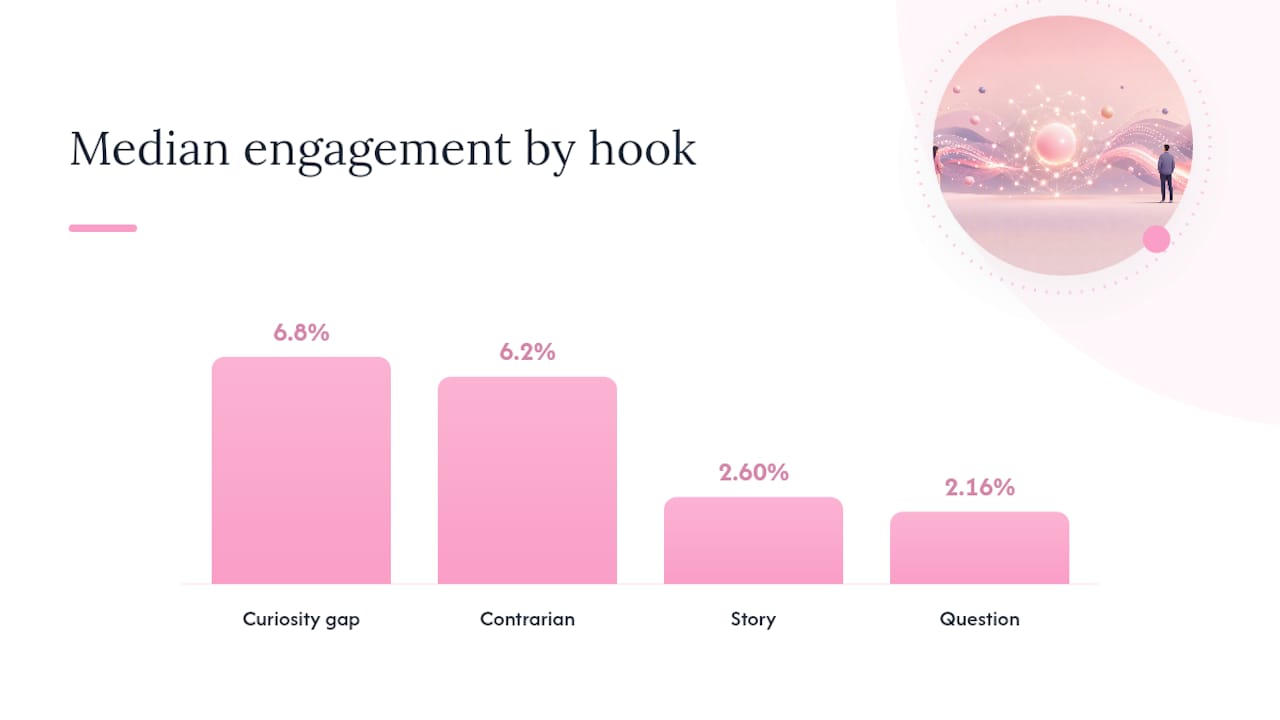
A second dataset cited in the same TryOrdinal analysis found curiosity gap and contrarian hooks averaging 6.8% and 6.2% engagement, roughly 2.3 times higher than other hook types tested. Here’s what each type does, and when to reach for it.
Story hooks open mid-scene, not at the beginning. They work because they promise a resolution, and people read to find out what happened.
- “I got fired on a Tuesday. Best thing that happened to my career.”
- “My client canceled a $40,000 contract in front of me. Here’s what I did next.”
- “Three years ago I couldn’t write a cold email. Last week I closed six deals from one.”
Contrarian hooks challenge something your audience believes, which creates immediate tension. They carry real risk: if you can’t back the claim in the body of the post, you lose credibility fast, not just engagement. Use them only when you have evidence, data, or a real case behind the claim.
- “Networking events are a waste of your time. Here’s what to do instead.”
- “Your resume isn’t the problem. Your LinkedIn headline is.”
- “Cold outreach doesn’t work anymore. This does.”
Curiosity gap hooks withhold one specific piece of information and promise to deliver it. The key word is specific. A vague tease reads as clickbait; a specific one reads as a promise.
- “One line in my proposal template tripled my close rate.”
- “There’s a scheduling trick recruiters use that candidates never see.”
- “I changed one word in my LinkedIn bio. Profile views doubled.”
Data and stat hooks lead with a number because numbers signal specificity and credibility before the reader has processed a single argument.
- “73% of hiring managers reject a resume in under 10 seconds.”
- “We tested 40 subject lines. Only 3 got above a 50% open rate.”
Direct callout hooks name the reader’s exact situation, which works well for niche or B2B audiences who feel like most content isn’t written for them.
- “If you’re a freelance consultant with under 500 followers, read this.”
- “For anyone hiring their first remote employee this quarter.”
Before/after hooks compress a transformation into one line, giving the reader a clear stake before they’ve read a single detail.
- “6 months ago: 200 followers. Today: 12,000 and three inbound clients.”
Story and contrarian hooks tend to win on reach and shares. Data hooks build authority faster. Direct callouts convert better when you’re targeting a narrow, specific audience rather than chasing broad visibility.
How Long Should a LinkedIn Hook Be? (The “See More” Fold)
LinkedIn truncates posts after roughly the first three lines on mobile and slightly more on desktop, then hides the rest behind a “see more” link. If your hook, your actual opening line, gets cut off mid sentence, the reader never sees the payoff that would make them click.
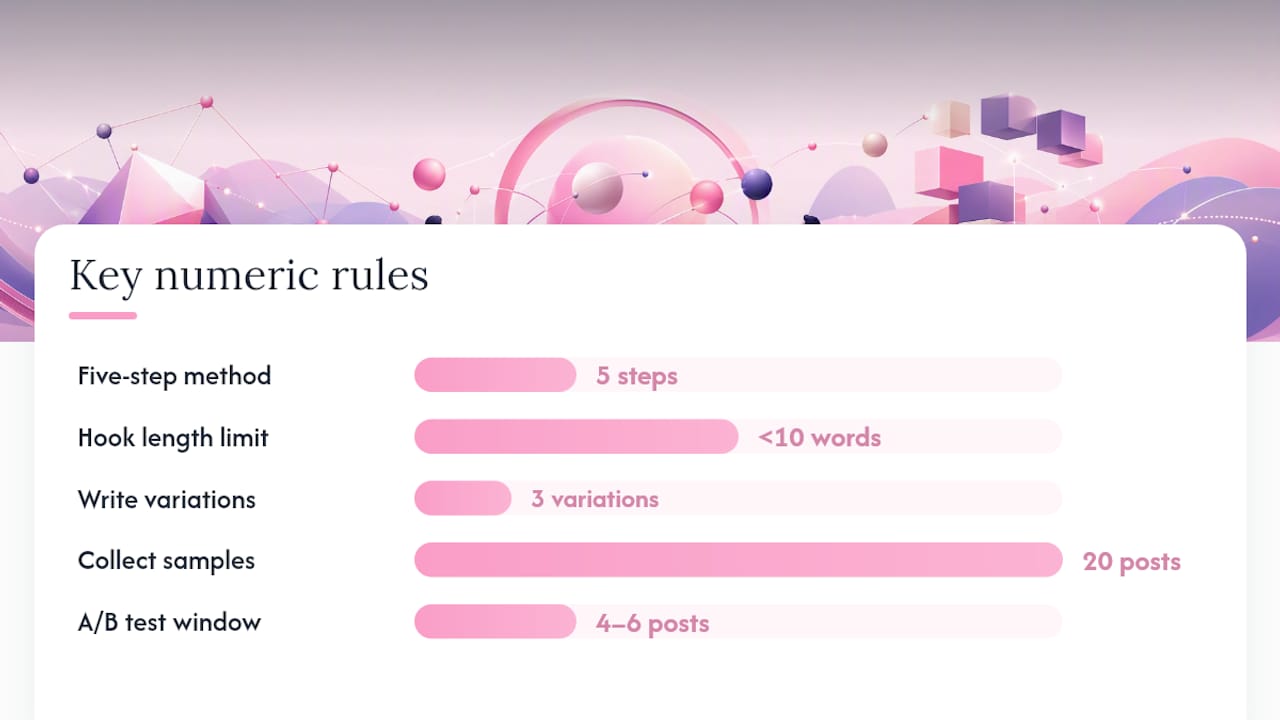
That’s why the working target is under 10 words and under 40 characters where possible. It’s not an arbitrary style preference. TryOrdinal’s analysis found hooks meeting that length outperformed longer ones by roughly 40% on expansion rate, the percentage of readers who click “see more” to keep reading.
Pro Tip: Bold your hook line when you draft it. If the bolded text alone makes sense and creates a question in your head, it will do the same for a scroller on mobile.
Before you publish, run this quick check:
- Copy your hook alone into a text box and count the characters. Aim for 40 or fewer.
- Preview the post in LinkedIn’s mobile app, not just the desktop composer. Mobile truncates sooner.
- Read only the visible portion, before “see more,” out loud. Does it stand on its own as a complete, intriguing thought?
- Cut filler words first: “I wanted to share,” “Just realized,” “So this happened.” None of them earn their place in line one.
The mechanical logic is straightforward: a hook that’s fully visible and ends on an open loop creates more expansions than a hook that’s either cut off mid thought or fully resolved before the click.
60+ Ready-to-Use LinkedIn Hook Examples by Goal
A long, uncategorized list of hooks is hard to use under deadline. Grouping templates by objective works better day to day than scrolling through 150 undifferentiated lines looking for one that fits. Below is a swipe file organized by what you actually want the post to do.
1. Hooks built for engagement (comments and shares)
- “Unpopular opinion: most career advice is outdated.”
- “I disagree with almost every productivity tip on this platform.”
- “Nobody talks about the real reason teams miss deadlines.”
- “Change my mind: remote work made managers worse, not better.”
- “The advice I ignored ended up being the advice that worked.”
2. Hooks built for authority (positioning you as the expert)
- “After reviewing 200 resumes this month, one mistake keeps repeating.”
- “I’ve hired 30 people. Here’s what actually predicts performance.”
- “Three years running a hiring desk taught me this.”
- “I built this system after failing at it twice.”
- “Most consultants get pricing wrong. Here’s the fix.”
3. Hooks built for credibility (data and proof upfront)
- “82% of the proposals I reviewed skipped this one section.”
- “We tracked 500 cold emails. The subject line mattered more than the offer.”
- “One client’s revenue doubled after we changed a single metric.”
- “The data on this surprised even me.”
- “Our churn dropped 18% after we fixed one onboarding email.”
4. Hooks built for shares (relatable or emotional openers)
- “I almost quit this industry last year.”
- “Nobody warns you about this part of running a business.”
- “This is the email I wish someone sent me at 22.”
- “I cried in my car after that meeting. Here’s why.”
- “The moment I stopped comparing myself to my competitors.”
Each template gets stronger with two quick edits. First, add a number wherever you can: “one mistake” becomes “this one mistake cost us $12,000.” Second, raise the stakes with a concrete detail: “a client canceled” becomes “a client canceled the day before launch.” Specificity is what separates a hook that reads like a template from one that reads like a real event.
A 5-Minute System to Write High-Performing Hooks Every Time
Writing the hook first is the mistake. A practical five-step method that consultants and content writers use produces stronger openings because it treats the hook as the last step, not the first.
- Write the full post without worrying about the opening line. Get the story, the argument, or the data down in a rough draft.
- Find the buried lede. Read back through your draft and find the single most surprising, specific, or emotional sentence, it’s often in paragraph three, not paragraph one.
- Move that sentence to line one. Cut it down to under 10 words if it isn’t already there.
- Write three variations of that line, one as a story fragment, one as a claim, one as a number. Pick the tightest one.
- Preview the fold, then publish and track. Check how the hook displays on mobile before you post, then note the expand rate after the first hour.
Two fast rewrite moves fix most weak hooks instantly. First, turn questions into claims: “Are you making this mistake?” becomes “This mistake costs teams $8,000 a quarter.” Second, add specificity anywhere you find a vague noun: “a client” becomes “a $2M SaaS client,” “recently” becomes “last Tuesday.”
Pro Tip: Keep a running document of every hook you write, even the ones that flopped. After 20 posts, you’ll start to see which structures your specific audience responds to, and that pattern matters more than any general rule.
Test one variable at a time, hook type or hook length, not both, across your next four to six posts before drawing conclusions.
How to Measure Whether Your Hook Is Working
Two numbers tell you almost everything: expand rate (the percentage of impressions that click “see more”) and engagement rate (reactions plus comments plus shares, divided by impressions). Expand rate tells you if the hook itself is doing its job. Engagement rate tells you if the whole post delivers on what the hook promised.
- Check performance in the first two hours. LinkedIn’s algorithm weighs early engagement heavily, so a slow start on that window usually means a weak hook, not bad luck.
- Give any single hook variation at least five to eight posts before judging it. One outlier post skews the read.
- No expands at all? The hook failed. Rewrite the opening line, not the body.
- Good expands but low engagement after that? The hook did its job. The post structure and body need work instead.
- Track both numbers in a simple spreadsheet by hook type, so patterns show up after a dozen posts instead of staying invisible in your head.
Common Hook Mistakes and How to Fix Them
Three mistakes show up more than any others: warming up before the point (“I’ve been thinking a lot about this lately…”), making a vague claim with no specific stakes (“This changed everything for me”), and burying the real story two paragraphs down. A synthesis of writing guides points to one root cause behind most weak hooks: they ask a question instead of making a claim, and the question isn’t specific enough to create real tension.
- Weak: “Have you ever struggled with hiring?” Strong: “I rejected 40 candidates last month for the same reason.”
- Weak: “Something interesting happened at work today.” Strong: “My manager apologized to me in front of the whole team.”
- Weak: “Is remote work really working?” Strong: “Our remote team outperforms our office team by every metric we track.”
Repeating the same curiosity bait post after post, or leading with a stat you can’t source, damages trust faster than a flat hook ever will.
The Data Behind These Rules, and Where Voselab Fits In
The pattern across datasets is consistent: hooks that make a specific claim beat hooks that ask a generic question, and hooks that fit above the fold beat hooks that get cut off mid sentence. LinkedIn’s own content guidance echoes this, pointing writers toward specificity, emotion, and lines that invite a reply rather than a passive scroll.
Short hooks that fit entirely above the “see more” fold create a mechanical advantage: visible completeness paired with a clear open loop drives more expansions than a hook that’s either truncated or fully resolved before the click.
Some post draft generators build openings shaped to a person’s actual writing style rather than a generic template. Results vary by audience and industry, and a contrarian claim that lands well in tech may fall flat in a more conservative field, so test before you commit to a hook style as your default.
Choosing Authenticity Over Optimization
Not every post needs the sharpest possible hook. A story worth telling in your own voice sometimes beats a perfectly engineered opener, especially when vulnerability is the point. For non-native English writers, tighten the hook’s length before you touch its voice. Cut words, don’t flatten tone. Keep a swipe file, keep testing, and let the data guide edits, not replace your judgment.
— Nurym
Try a Hook Written in Your Own Voice
Most writers lose time rewriting the same opening line five different ways, guessing which version will actually clear the fold. Some services generate personalized LinkedIn post drafts that adapt to how you already write, so the hook sounds like you, not like a template pulled from a swipe file.
It fits freelance consultants, jobseekers, and time-constrained professionals who need a strong opening line without spending an hour drafting one from scratch. You can give the post generator a try with a free first post, feed it a rough idea in text or voice, and get an editable draft with the hook already tightened for the fold. If you want to see the full range of what it can produce, start with Voselab and generate your next post.
Sources
- LinkedIn Hooks: What Gets Engagement (2026 Data)
- How to Write LinkedIn Hooks That Stop the Scroll (30 Examples)
- LinkedIn Post Hooks: 100+ Examples by Type (2026)
FAQ
What is the 3/2/1 rule on LinkedIn?
It’s a posting cadence guideline: roughly 3 engagement posts, 2 authority posts, and 1 promotional post per week, though exact ratios vary by creator and industry.
What is the 4-1-1 rule on LinkedIn?
It suggests posting four pieces of helpful or entertaining content, one soft share about your work, and one direct promotional post, keeping self-promotion a small fraction of your feed presence.
What are some good examples of LinkedIn posts that perform well?
Posts built around a specific story, a contrarian claim backed by evidence, or a concrete number tend to outperform generic advice posts or plain questions, based on engagement data across hundreds of thousands of posts.
How do you make a LinkedIn post more engaging?
Open with a hook under 10 words that makes a specific claim rather than a vague question, keep it visible above the “see more” fold, and back any bold statement with a real detail or number in the body.
Can a tool actually write a strong hook for me?
A tool like Voselab can generate a draft hook shaped to your writing style and the post’s content, but the strongest results still come from reviewing it against the length and specificity checks covered above.