Saveable Content Wins on LinkedIn in 2026: A Practitioner’s Playbook
LinkedIn’s 2026 algorithm now runs on a unified LLM that ranks posts by semantic relevance instead of raw engagement volume. That means the single most important adaptation is aligning your profile and content around two or three clear topics, then producing saveable, substantive posts. Expect broad reach to drop on filler content, while genuine topical expertise earns steadier, more durable visibility.
TL;DR:
- Posts that focus on two or three specific topics and offer substantive, repeatable ideas tend to perform better in the new algorithm than filler content or broad coverage.
- External links in posts should be moved to comments, as linking directly in the body significantly reduces reach, especially for posts with low intrinsic topical relevance.
- Engagement signals now favor saves and meaningful comments over likes, with a high saves-to-likes ratio indicating content that provides lasting reference value.
- Document carousels and newsletters outperform videos and short posts in terms of engagement, dwell time, and overall distribution under the updated ranking system.
- Authenticity and topical consistency are crucial; avoiding coordinated engagement schemes and generic AI templates help prevent content suppression and improve visibility.
Table of Contents
- How the LinkedIn Algorithm Update in 2026 Changed the Feed
- How LinkedIn’s Feed Algorithm Works Now: Retrieval, Embeddings, and Ranking
- Which LinkedIn Engagement Signals Matter Most in 2026?
- What Content Formats Perform Best on LinkedIn Right Now
- A Prioritized Checklist to Adapt to the 2026 LinkedIn Algorithm
- Common Mistakes That Get LinkedIn Posts Suppressed
- How to Measure and Test LinkedIn Content Changes
- A Practical Example: Turning a Shallow Post Into a Saveable Asset
- Personalized vs. Network-Based Recommendations on LinkedIn
- AR/VR Posts, Creator Events, and Emerging Formats
- How Skills and Endorsements Factor Into Content Ranking
- Using LinkedIn Groups and Communities Under the New Algorithm
- What Actually Wins on LinkedIn in 2026
- Let Voselab Handle the Rework While You Focus on the Work Itself
- Sources
- FAQ
How the LinkedIn Algorithm Update in 2026 Changed the Feed
LinkedIn deployed a unified large language model to power feed retrieval and ranking in March 2026, replacing what had been five separate retrieval pipelines with one system. The engineering team’s own account of the rebuild, referenced widely as the “Engineering the next generation of LinkedIn’s Feed” announcement, frames this as a move from pattern matching toward genuine semantic understanding of what a post is actually about.
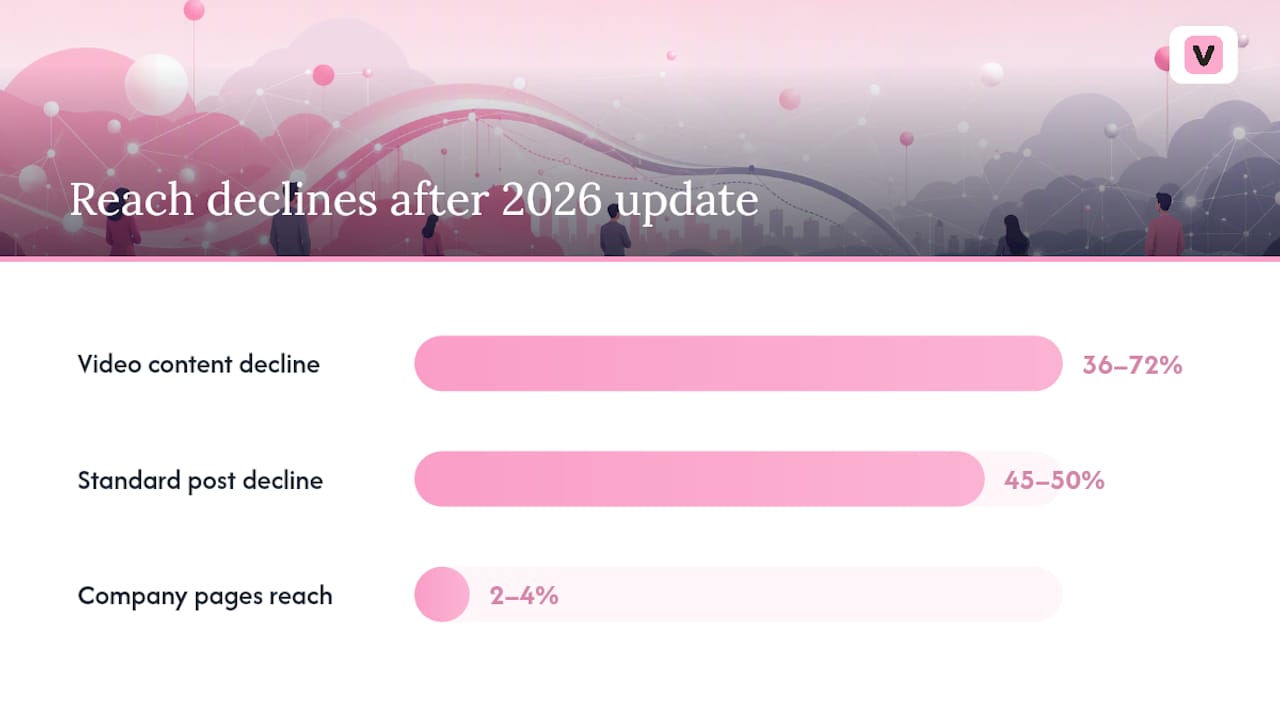
The practical fallout has been rough for anyone posting on autopilot. Socialinsider’s analysis found reach declines of 36% to 72% for video content and 45% to 50% for standard posts. Company pages now reach just 2% to 4% of their followers organically. Posts with external links can see significant reach penalties, indicating that LinkedIn wants attention to stay on-platform.
This isn’t a “post less” story. It’s a “post differently” story. LinkedIn’s own reporting describes the shift as treating posts and member profiles as semantic vectors, matched through LLM-powered retrieval and sequential ranking rather than keyword or engagement-count matching alone.
For content teams adjusting in real time, a few immediate moves separate the posts that survive this shift from the ones that quietly vanish:
- Do narrow your posting to two or three recurring topics so your profile reads as a coherent expertise signal.
- Do build posts around a specific, useful idea readers would want to revisit, not a reaction to news of the day.
- Don’t rely on external links in the body of a post; put them in the first comment instead.
- Don’t assume video is a safe default. It’s taken some of the steepest reach hits of any format.
- Don’t measure success by impressions alone. Reach is down across the board, and that’s expected.
The teams adapting fastest are treating this less like a distribution algorithm and more like a recommendation engine that has to be convinced you’re a credible source on a specific subject.
How LinkedIn’s Feed Algorithm Works Now: Retrieval, Embeddings, and Ranking
Understanding the mechanics helps explain why certain tactics work and others quietly fail. LinkedIn’s system runs in two stages, and both matter for how you write and structure a post.
Stage one: retrieval. Instead of pulling candidate posts by keyword overlap or follower graph alone, the model converts posts and profiles into dense numerical representations called embeddings. Think of an embedding as a fingerprint of meaning: two posts about supply chain risk will sit close together in this space even if they don’t share a single word in common. This is what lets LinkedIn narrow millions of possible posts down to a manageable candidate set for any given member, based on topical closeness rather than surface-level matching, as described in Search Engine Land’s coverage of the retrieval overhaul.
Stage two: sequential ranking. Once candidates are retrieved, a transformer-based ranker orders them by predicting what you’re likely to do next, based on your recent sequence of actions, not just your static profile data. The LiRank research from LinkedIn’s engineering team describes this architecture combining Residual DCN layers, transformer blocks, and profile embeddings in production. If you’ve saved three posts about pricing strategy this week, the model treats that as an emergent interest and boosts related content further than it would from a single isolated engagement.
A few engineering details explain behavior you might have noticed but couldn’t quite name:
- Numeric engagement signals (likes, comments, shares) get converted into percentile buckets rather than raw counts, so a post’s performance is judged relative to typical posts, not by absolute numbers.
- Profile embeddings are merged into the ranking process through late fusion, meaning your stated skills and history get blended in after initial candidate scoring, not before.
- The system balances explore versus exploit, occasionally surfacing content outside your usual pattern to test whether your interests are shifting.
Pro Tip: Write your headline and About section using the exact terms you want your posts associated with. Profile embeddings feed directly into ranking, so vague titles like “Consultant” give the model less to match against than “B2B Pricing Strategy Consultant.”
VentureBeat’s reporting on the retrieval unification notes this consolidation was partly an infrastructure decision, folding five separate systems into one model to cut complexity, and partly a quality decision, since a single LLM can capture nuance that fragmented pipelines missed. Either way, the result is a feed that increasingly rewards people who show up consistently around a defined area of expertise, and increasingly ignores those who don’t.
Which LinkedIn Engagement Signals Matter Most in 2026?
Not every reaction carries equal weight anymore. Reporting from Forbes on the 2026 changes puts saves at roughly five times the ranking value of a like. That gap should reshape how you write.
Here’s how the current signal hierarchy tends to play out in practice, ranked from highest to lowest impact on distribution:
- Saves — the strongest indicator that a post has lasting reference value, not just momentary interest.
- Dwell time — how long someone actually stays on your post before scrolling past, which the sequential ranker tracks as part of the interaction trajectory.
- Substantive comments — replies with real content, not “Great post!” or a string of emoji.
- Shares with commentary — someone reposting your idea in their own words to their network.
- Likes — still counted, but now the weakest signal in the stack.
A high saves-to-likes ratio is one of the clearest tells that content is landing as genuinely useful rather than merely agreeable. A post earning 40 saves against 200 likes is outperforming, in the algorithm’s eyes, a post with 10 saves and 800 likes, even though the second post looks more “successful” on the surface.
Statistic Callout: Early, authentic replies from relevant professionals within the first 60 to 90 minutes of publishing correlate with a 35% visibility boost for posts that go on to earn wider distribution, according to Forbes reporting.
This “golden hour” window matters, but the source of those early comments matters just as much as their timing. A handful of thoughtful replies from people who genuinely work in your field reads as a legitimate signal to the ranking model. The same volume of comments from an engagement pod, a coordinated group of accounts that like and comment on each other’s posts on schedule, tends to trigger the opposite outcome. LinkedIn’s detection systems are built to spot the pattern, not just the count.
What Content Formats Perform Best on LinkedIn Right Now
Format choice now has a direct, measurable effect on which signals a post can even generate. Some formats are structurally built for saves; others are built for a quick scroll and nothing more.
- PDF carousels and documents are the standout performer, with median engagement around 21.8%, roughly three times what many creators see from video. Structure them as a sequence with one clear idea per slide, a strong hook slide, and a final slide that prompts a save for later reference.
- Newsletters and long-form reference posts work as evergreen assets. A well-built newsletter issue keeps generating dwell time and saves for weeks, unlike a single post that peaks within a day or two.
- Native video still earns strong distribution when it clears a real production bar, but it’s taken some of the steepest reach hits of any format and punishes low-effort clips harder than before.
- Short posts and text threads can still work, but they need a structural hook in the first two lines and a reason to keep reading, since dwell time is now a ranking input, not an afterthought.
If you’re only adopting one format change this quarter, converting a strong post into a document carousel is the highest-leverage move available.
A Prioritized Checklist to Adapt to the 2026 LinkedIn Algorithm
Adapting to this shift doesn’t require a total content overhaul overnight. Spread the work across three horizons.
In the next two to three weeks:
- Rewrite your headline and About section to reflect two or three specific topics, not a generic job title.
- Audit your last 20 posts and flag which ones align with those topics versus which ones were off-topic reactions or reposts.
- Stop linking out in post bodies; move any external link to the first comment.
- Pick your two or three core topics and commit to them for at least a quarter before evaluating.
Over the next one to three months:
- Take your two or three best-performing posts from the past year and rebuild them as document carousels.
- Run small, honest engagement tests, asking a handful of genuine colleagues to read and comment substantively within the first hour of publishing, rather than using automated pods.
- Settle on a sustainable posting cadence rather than posting daily out of habit. Quality per post now matters more than frequency.
- Start a newsletter if you haven’t, focused on one recurring theme your audience can rely on.
Ongoing practices:
- Track your saves-to-likes ratio and dwell time alongside reach, not instead of it.
- Read every comment your posts receive and reply with substance, since that continues the interaction trajectory the ranker is watching.
- Avoid any tool or group promising guaranteed engagement. If it looks automated, the detection systems are built to treat it that way.
Pro Tip: Set a recurring 15-minute calendar block each Monday to review last week’s saves and dwell numbers before you plan new posts. Reacting to real signals beats guessing at what “should” perform.
Common Mistakes That Get LinkedIn Posts Suppressed
Certain behaviors now carry real penalties instead of just diminishing returns. Recognizing them matters more than any formatting trick.
- Engagement pods and coordinated activity rings, where a group of accounts systematically engage with each other’s posts on a schedule, are actively detected. Forbes reporting on the 2026 changes notes shadow bans lasting 60 to 90 days for accounts caught in coordinated rings.
- Generic AI-generated templates with no distinct voice or specific insight get deprioritized in retrieval, since the embedding model can identify formulaic, low-substance patterns at scale.
- Excessive posting frequency, publishing multiple times daily out of habit, dilutes your topical signal rather than strengthening it.
- Over-tagging and mechanical engagement bait (“Comment YES if you agree,” tagging 20 people who have no connection to the topic) reads as manipulation to a model trained to spot the pattern.
The common thread across all four: LinkedIn’s ranking now actively looks for authenticity signals, and shortcuts that used to work are the same shortcuts the model is specifically built to catch.
How to Measure and Test LinkedIn Content Changes
Before you overhaul your content strategy, decide what you’re actually going to track. Reach alone is a misleading metric in 2026, since platform-wide declines mean a lower number doesn’t necessarily mean you’re doing worse.
Build your KPI dashboard around these five metrics:
- Reach, tracked as a baseline trend rather than a single-post scorecard.
- Saves, the clearest quality signal available to you directly.
- Dwell time, visible in LinkedIn’s native analytics for document and video posts specifically.
- Quality comments, meaning replies with substance, tracked manually if the platform doesn’t quantify this for you.
- Saves-to-likes ratio, your fastest gut check on whether a post is genuinely useful or just agreeable.
Run changes as small, repeated experiments rather than one-off tests. Because ranking is personalized and sequential, a single post’s performance is noisy. A practical testing note from Forbes’ 2026 coverage suggests prioritizing relative lifts in saves and dwell across a series of posts over raw view counts on any single post, since that reduces the influence of one lucky or unlucky feed placement.
Give any format or topic change at least three to five posts before judging it. One document carousel that underperforms doesn’t mean the format failed. A consistent pattern across five carousels tells you something real.
A Practical Example: Turning a Shallow Post Into a Saveable Asset
Here’s how a rework typically goes. Start with a post that got strong likes but almost no saves, often a hot take or a reaction to industry news with no lasting reference value. Break its core idea into five to seven discrete steps or principles, then rebuild it as a document carousel with one idea per slide and a clear “save this for later” close.
- Cut generic phrasing that reads as AI-written, vague transitions, hedge words, and sentences that could apply to any industry.
- Replace it with specific numbers, named tools, or a real scenario from your own work.
- Add a genuinely useful summary slide, since that’s often the moment someone decides to hit save.
Editorial guidance on content writing leans on this principle: strip the phrasing that makes a post read like generic AI output, and replace it with the specific detail only you could provide. Nurym’s advice on removing ChatGPT-style generic phrasing centers on this exact swap.
Pro Tip: Expect saves to rise before dwell time does. Give a reworked post two to three weeks of data before judging whether the format change is working.
Personalized vs. Network-Based Recommendations on LinkedIn
LinkedIn’s feed now blends two distinct recommendation logics, and understanding the balance changes how you think about audience growth. Network-based recommendations, showing you posts from people you follow or are connected to, still exist as a baseline. But the LLM-driven retrieval layer increasingly surfaces content based on topical alignment with your embedding, regardless of whether you follow the author.
This is why a post from someone outside your network can now show up prominently in your feed if it matches a subject you’ve engaged with repeatedly. The LiRank framework supports this kind of cross-network surfacing by modeling interest through sequential behavior rather than connection graphs alone.
For creators, the implication cuts both ways. You’re no longer limited to your existing follower count for meaningful reach, since a genuinely relevant post can reach professionals who’ve never heard of you. But you’re also competing against every relevant voice on the platform, not just the people your audience already follows. The practical takeaway is straightforward: growing your network still helps, but growing your topical consistency now matters just as much, since that’s what makes the model surface you to strangers who share your interests.
AR/VR Posts, Creator Events, and Emerging Formats
LinkedIn has been testing immersive and event-based formats alongside its core feed, and the 2026 ranking model treats them differently than static posts. Live video and creator events generate real-time engagement signals, comments during the broadcast, attendance duration, follow-up saves of the recording, that the sequential ranker can weigh more heavily than a single static post’s performance.
AR and VR-style posts remain a smaller, experimental category, and there isn’t yet a robust body of performance data comparable to what exists for documents or video. Treat early adoption of these formats as a positioning move rather than a guaranteed reach strategy. The safer bet for most professionals and marketers is treating LinkedIn Live sessions and creator events as extensions of your core topical strategy, not a separate content lane.
If you host a Live session, the follow-up matters as much as the event itself. Clip the strongest segment into a short document or video recap within 24 hours, while the topic still has momentum in your network’s feed. That recap can independently earn saves from people who missed the live session, effectively giving one piece of content two distinct chances at distribution.
How Skills and Endorsements Factor Into Content Ranking
Your listed skills and endorsements aren’t just profile decoration anymore. Because profile embeddings get fused into the ranking process, the skills you list contribute to how the model classifies your topical authority, which in turn affects which posts of yours get surfaced to which audiences.
A profile listing “pricing strategy,” “B2B negotiation,” and “SaaS revenue models” as skills, backed by endorsements from people whose own profiles signal relevant expertise, gives the model a stronger topical anchor than a profile with generic skills like “communication” or “leadership.” This doesn’t mean endorsements directly boost individual posts. It means they shape the baseline classification of who you are, which affects every post you publish afterward.
The practical move: audit your skills section the same way you’d audit your headline. Remove vague, generic entries and replace them with the specific terms that match the two or three topics you’ve committed to. Ask a handful of genuine colleagues, people who actually know your work, to endorse the skills that matter most. Quality of endorser matters more than quantity here, since the model has access to the endorser’s own profile signals, not just a raw count.
Using LinkedIn Groups and Communities Under the New Algorithm
Groups have historically been an underused corner of LinkedIn, and the 2026 shift toward topical relevance makes them more valuable, not less. A group built around a specific professional niche functions as a concentrated pool of the exact audience the retrieval model is trying to match you against.
Posting inside an active, relevant group gives you two advantages the open feed doesn’t. First, the audience is pre-filtered by shared interest, so early engagement tends to come from genuinely relevant professionals rather than a random cross-section of your broader network, which supports the kind of authentic golden-hour signal the ranking model rewards. Second, group discussions generate exactly the kind of substantive comment threads that outperform simple reactions.
The strategy isn’t to join every group in your industry. Pick two or three active groups where real discussion happens, not just link-drops, and contribute consistently rather than promotionally. Answer questions in depth before you ever post your own content there. That consistency builds a reputation within the group that translates into real engagement when you do share your own work, engagement that’s harder to fake and more valuable to the algorithm than a broadcast post to your full network.
What Actually Wins on LinkedIn in 2026
The creators who are thriving right now aren’t the ones posting the most. They’re the ones who picked a lane and stayed in it long enough for the model to recognize them as a credible source on that subject. That’s the uncomfortable part for a lot of marketers used to chasing daily reach, since consistency now beats frequency by a wide margin.
A quick before-and-after makes the point concretely: a founder’s post reacting to industry news, four sentences, no structure, decent likes, almost zero saves, reworked into a five-slide carousel breaking down the same insight as a repeatable framework. Same idea, radically different distribution outcome.
— Nurym
Let Voselab Handle the Rework While You Focus on the Work Itself
Rebuilding your content strategy around saves, dwell time, and topical consistency takes real editing skill, and most professionals don’t have three extra hours a week to rework old posts into carousels or rewrite their profile from scratch. There are tools that generate personalized LinkedIn posts and articles that adapt to your own writing style, then let you edit tone and structure before anything goes out.
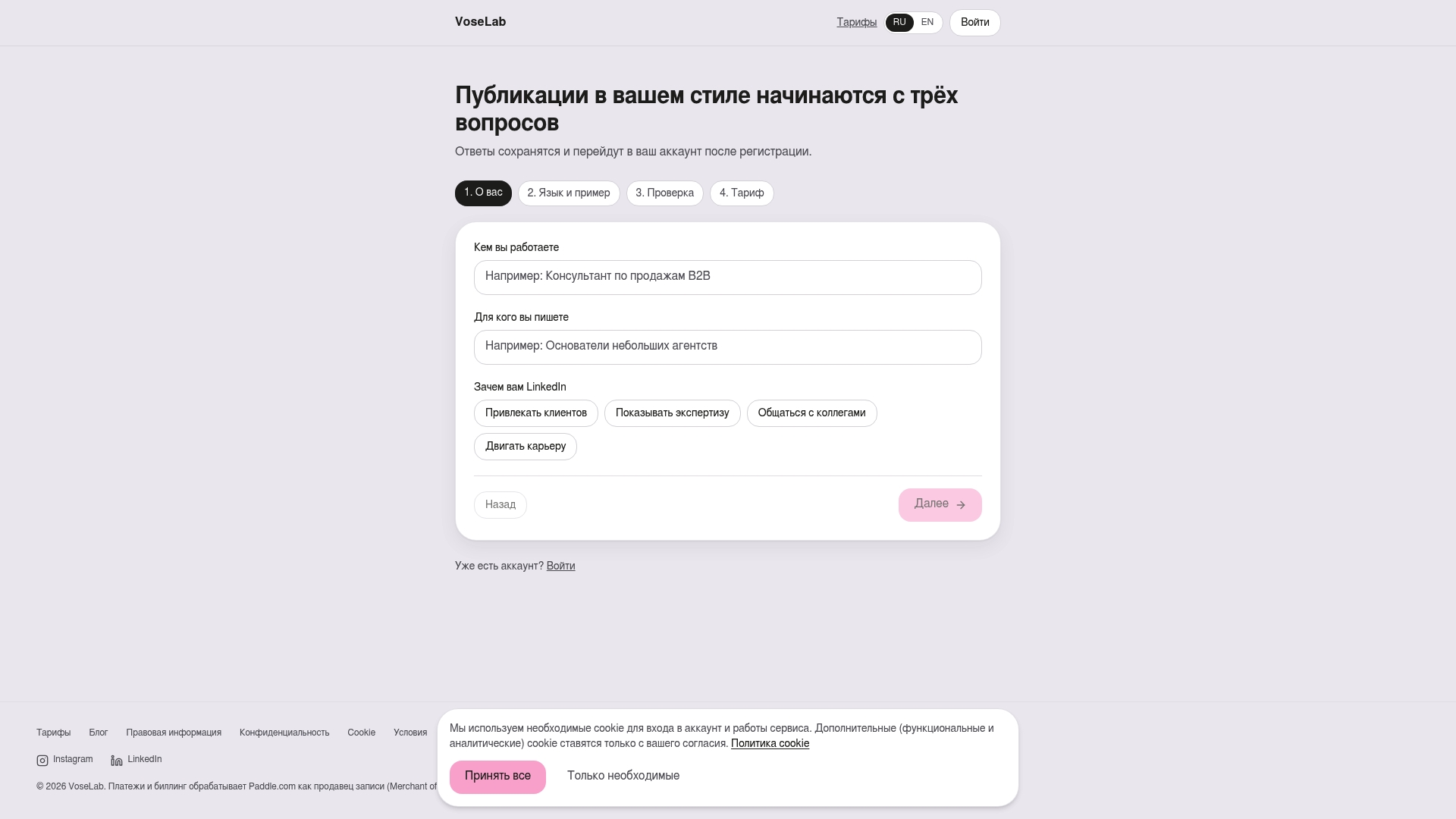
You can provide your material as text, a file, or even a voice note, and it can be turned into a draft built around your voice rather than a generic template, addressing the issue that generic AI-sounding content gets deprioritized under the current model. If you’re a freelance consultant, job seeker, or business owner who wants to show up consistently around two or three topics without spending your evenings reformatting old posts, this is the shortcut. Try Voselab’s LinkedIn post generator with a free trial post and see how a draft built around your own voice compares to what you’d write from scratch.
Sources
For deeper technical grounding, LinkedIn’s engineering team’s own account of the March 2026 deployment, referenced in coverage from Falia, lays out the shift to unified LLM retrieval. The LiRank paper on arXiv documents the production ranking architecture in technical detail. Search Engine Land, VentureBeat, and Forbes each cover the reach and format shifts from an industry-reporting angle worth reading in full.
- Socialinsider — LinkedIn algorithm (2026) analysis
- Search Engine Land — LinkedIn updates feed algorithm with LLM-powered ranking and retrieval
- LiRank: Industrial Large Scale Ranking Models at LinkedIn (arXiv)
- Forbes — 9 recent LinkedIn changes affecting your reach
- VentureBeat — How LinkedIn replaced five feed retrieval systems with one LLM model
FAQ
What Is the 3/2/1 Rule on LinkedIn?
The 3/2/1 rule is an informal posting guideline suggesting three engagement actions (comments on others’ posts), two shares, and one original post per day to build visibility through reciprocity. Under the 2026 algorithm’s emphasis on saves and dwell time, the quality of that one original post now matters more than hitting a fixed daily ratio.
Is LinkedIn Still Relevant in 2026?
Yes. LinkedIn remains a primary channel for professional visibility, though the 2026 algorithm has made organic reach harder to earn, with company pages now reaching only 2% to 4% of followers. Relevance hasn’t declined, but the bar for what earns distribution has risen significantly.
How Do You Stand Out on LinkedIn in 2026?
Standing out now depends on topical consistency and saveable content rather than posting frequency. Align your profile around two or three specific areas of expertise, publish document carousels and reference posts that earn saves, and avoid engagement bait or coordinated pod tactics that the ranking model actively penalizes.
What Are the Top LinkedIn Trends for 2026?
The dominant trend is the shift to LLM-driven, semantic-relevance ranking, which favors document carousels, newsletters, and native video that clears a real production bar over quick reactive posts. Saves and dwell time have overtaken likes as the signals that drive distribution, and tools like Voselab’s post generator reflect the broader move toward voice-consistent, personalized content over generic templates.
Why Did My LinkedIn Reach Drop in 2026?
Reach declines are widespread and expected under the new model, with standard posts seeing drops of 45% to 50% and video seeing even steeper declines. A drop in raw reach doesn’t necessarily mean your content is underperforming if your saves and dwell time are holding steady or improving.